Celebrating Professor John L. Esposito’s Scholarship on Islam and the Middle East

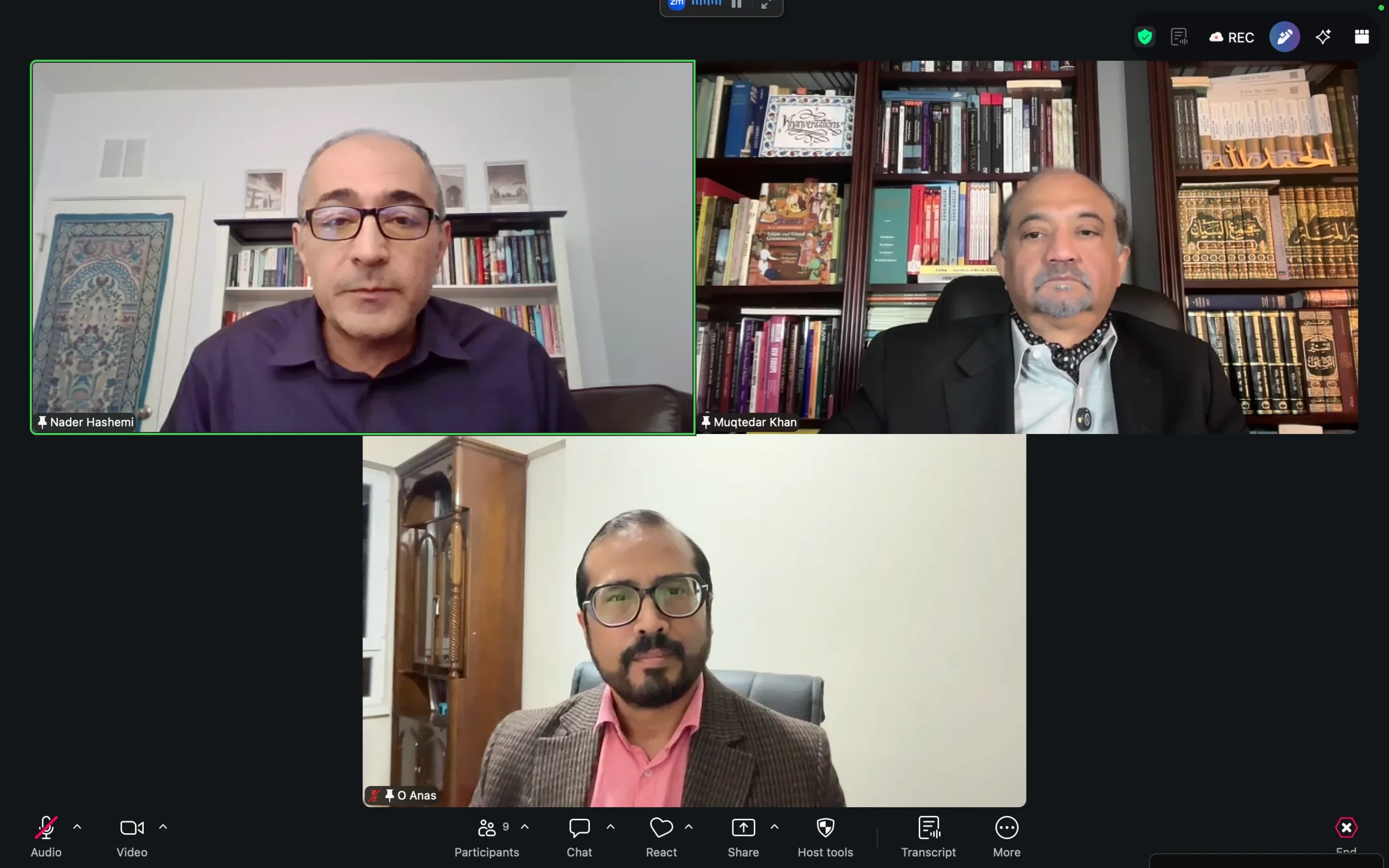
The International Dialogue and Diplomacy Foundation (IDDF) hosted a distinguished online lecture celebrating the scholarly legacy and profound impact of Professor John L. Esposito on Islamic studies, West Asian geopolitics, and comparative religion. The session was chaired by Professor Muqtedar Khan of the University of Delaware, who was Professor Esposito’s first direct PhD student, and featured Professor Nader Hashemi, Director of the Alwaleed Center for Muslim-Christian Understanding at Georgetown University, as the keynote speaker, alongside opening remarks by IDDF Director Dr. Omair Anas.
Opening the session, Dr. Omair Anas reflected on how Esposito’s foundational work transformed the study of Islam by breaking away from securitized frameworks. Highlighting his personal introduction to Esposito’s literature during post-2001 global counter-terrorism debates, Dr. Anas noted that “the book does not treat Muslims as other,” observing that while Islamic studies had long been securitized and treated as a security challenge, Esposito left behind a legacy where “both Muslims and non-Muslims are equally celebrating his legacy”.

Professor Muqtedar Khan expanded on Esposito’s monumental impact on Western academia, framing him as the intellectual successor to Edward Said who successfully dismantled Orientalist biases. Reflecting on this paradigm shift, Professor Khan stated, “If you asked me to identify one single achievement of Esposito, I would say that he took the ball from Edward Said… and he created a post-Orientalist academia in the world”. Furthermore, he highlighted how Esposito challenged prevailing dogmas regarding the supposed incompatibility of Islam with modernity, pluralism, and democracy.

Professor Nader Hashemi focused on Esposito’s theoretical breakthroughs in challenging modernization theory and its inherent secular biases, which historically posited that societies must secularize in order to develop. Discussing Esposito’s revolutionary approach to the study of Muslim societies, Professor Hashemi stated, “John Esposito shattered that entire framework and posited a different way of thinking about the relationship between Islam and politics by looking at society from the bottom up rather than top down, challenging the US and Israeli-centered national security frameworks”.

Professor Hashemi also emphasized that Esposito’s core academic and ethical objective was rooted in fairness and rigorous comparative scholarship. Concluding on this vision, he remarked, “John Esposito really, you know, just wanted scholars, intellectuals, policymakers to judge Islam by the same standards that we would judge any other civilizational or religious tradition. Judge it by the mainstream, not by the lunatic or extremist fringe”. The lecture concluded with a vibrant Q&A session moderated by Professor Khan and Dr. Anas, addressing global Islamophobia and the future of post-Orientalist research.
IDDF
IDDF is a Fellow at IDDF focusing on strategic analysis and international policy.
View all articles →